Val d'Orcia in April and May is a different region from the August postcards. Wildflowers along the SP146, the lambs, the cantinas at their easiest. The editor's view of the most photographed weeks of the Tuscan year.
From the founders·6 min read
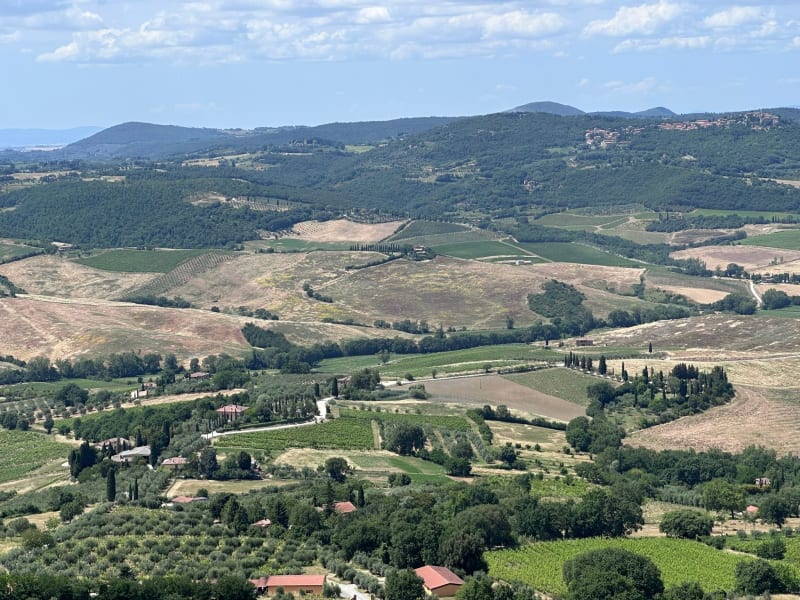
The Val d'Orcia in May is essentially a different region from the Val d'Orcia in August. The dust-and-amber landscape that the August postcards show, the cypresses against pale-gold wheat, the sun-bleached stone, is replaced for six weeks each spring by a register so different that some first-time visitors arriving in May genuinely think they are in the wrong valley. The wheat is at full chest-high green, sometimes still pale and feathery; the wildflowers along the verges are at their full intensity; the lambs are out; the morning fog rises from the lower valleys at six and is gone by nine; the air is twelve degrees cooler than the worst August afternoon. It is, by some distance, the right time to be in this region for guests who care about landscape.
This piece is the case for the Val d'Orcia spring, week by week from late March through late May, and the practical ground for arranging a stay.
When the spring runs
The Val d'Orcia spring is structurally about six weeks, beginning in the second half of March and finishing around 1 June. Within that window, there are roughly four phases.
*Late March to mid-April, primavera precoce*** (early spring). The wheat fields are starting to come up but are still pale and uneven. The morning fog is dense; daytime highs are 12–17°C; many of the smaller hilltop trattorias are not yet at full season opening. Easter often falls in this window and brings a brief week of high pressure on accommodation.
Mid-April to early May, the photographer's window. The wheat is at full chest-high green, the wildflowers are at their first peak (the poppies appear later), the cypresses are at their darkest contrast against the green. Daytime highs are 16–21°C; rainfall is normal but light. The strongest single window for landscape photography in the Val d'Orcia.
Mid-May to end of May, the poppy weeks. The wheat is starting to lighten in colour; the poppies (papaveri) are at full intensity, particularly along the SP146 between Pienza and Montepulciano and in the fields below the Cappella di Vitaleta. Daytime highs are 19–24°C; the light is at its longest of the year (sunset around 8:45pm).
Late May into early June, the pivot to summer. The wheat is starting to amber; the poppy density is reducing; daytime highs are reaching 25°C. The first proper warm days of the year on the SR2 are usually around 25–28 May.
The mornings
The Val d'Orcia mornings in spring are the entire reason for the season. Three things make them what they are.
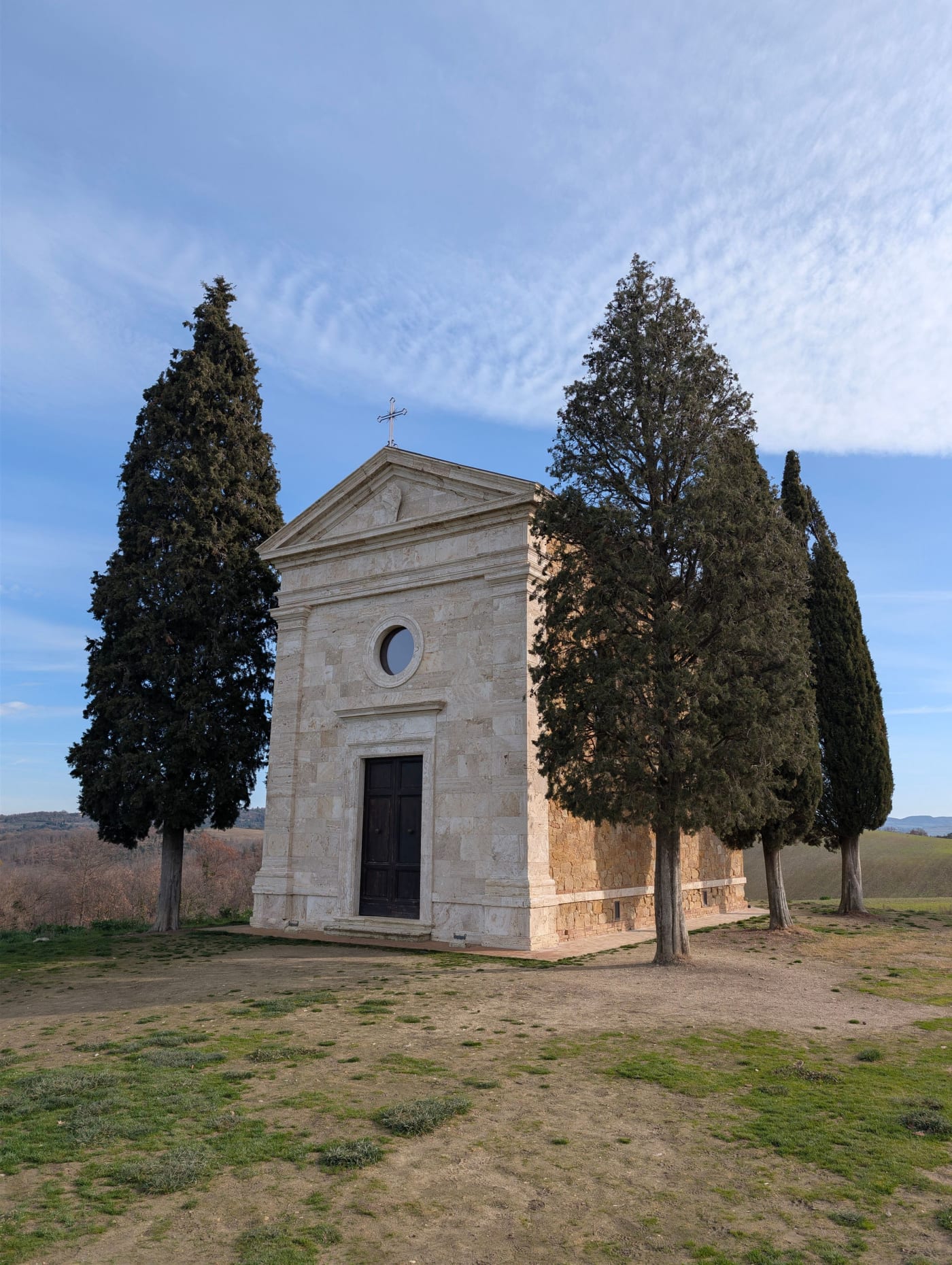
The fog. The valley floors, particularly between Pienza and San Quirico, and on the slopes below Sant'Antimo, fill with a low ground-fog that begins to form around 4am and is completely gone by 9am. The Cappella di Vitaleta photographed at 6:30am with the fog rising around it is the canonical image of the region; the SP146 between Pienza and Montepulciano at 7am with the fog filling the valley below is, in our editorial view, the more rewarding version of the same morning.
The light. Spring light in Tuscany is structurally different from autumn light. The autumn version is golden and warm; the spring version is pale and even, with high blue saturation in the sky. The two work for different photographic registers and the right serious traveller chooses between them by intention.
The sound. The Val d'Orcia in May has, before nine in the morning, the soundscape of an unusually intact agricultural valley, sheep bells (the lambs are out), the occasional rooster, distant bird calls in the hedgerows, almost no traffic. By ten, the cars start arriving on the SR2 from Florence and the soundscape compresses; by 6pm, after the day-trippers have left, it returns.
The right structural pattern for a Val d'Orcia spring week is to be out of the villa by 6:30am for three or four mornings of the week, typically with a flask of coffee, a camera, and a route plan. The afternoons are for the cantinas, the towns in their post-riposo register, and the long slow lunch.
What to do
A short list, the right things in spring.
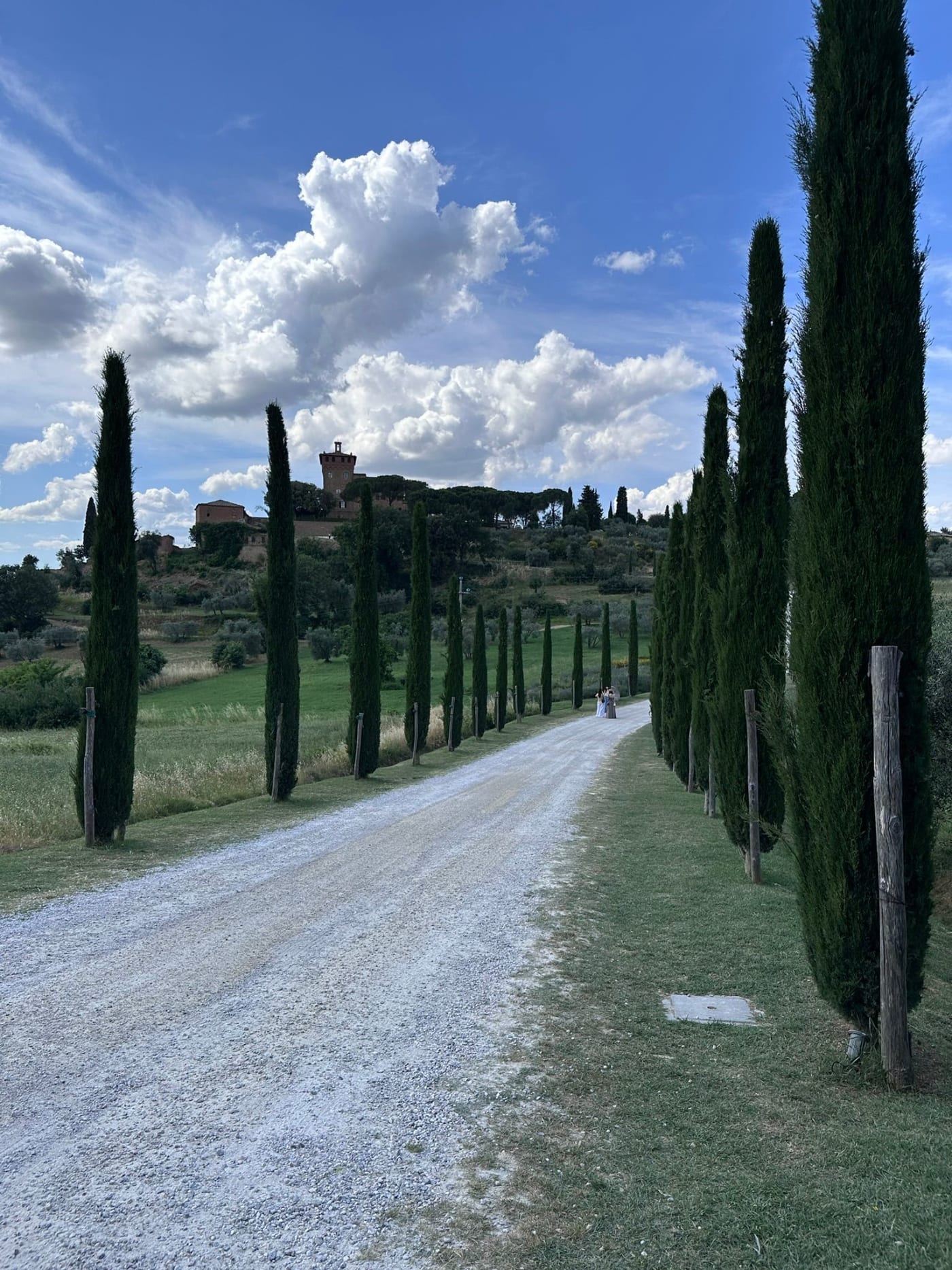
Drive the SP146 between Pienza and Montepulciano at first light. The visual signature road of the region. 25 km, 35 minutes if you stop for nothing, two hours if you stop properly.
Walk the Cappella di Vitaleta access path. The 500-metre walk from the parking pull-off to the chapel is at its strongest in the early morning fog. Sunrise and the first hour after.
Visit the Abbazia di Sant'Antimo at vespers. The 12th-century Romanesque abbey, ten minutes south of Montalcino, hosts daily Gregorian chant for vespers (about 6:30pm in spring). The acoustic in the abbey at vespers is one of the under-recognised great moments of the Tuscan year.
Taste Brunello at one of the named producers. The April-and-May visits to the Montalcino cantinas are at their easiest of the year. Brunello di Montalcino requires a minimum five-year aging (six for Riserva), so spring tastings include the full vertical of the previous decade. Don Federico Cassi at Tenuta del Faggio is the right host for a serious morning vertical; we arrange.
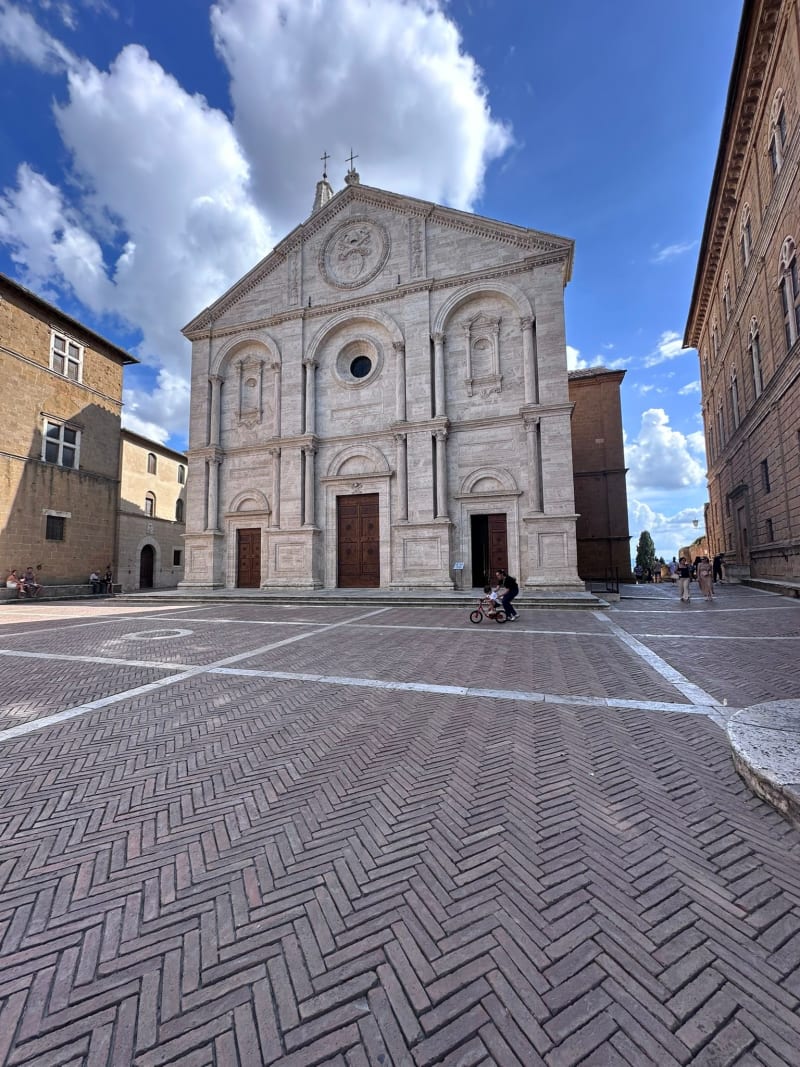
Walk Pienza in the cool of the morning before the day-trippers arrive. 8am to 10am is the right window. The Piazza Pio II at first light, the loggia of the southern walls (Via dell'Amore) at 9am with the valley fog clearing below.
Visit the Bagno Vignoni thermal pool in the cool of the morning. The 16th-century thermal pool in the centre of the village is the principal piazza; the small public bagno (hot pool) below the village is the more atmospheric soak. April mornings, when the air is cool but the water is hot, are the right combination.
Eat the seasonal lambs.Agnello da latte (suckling lamb) is the Easter-and-spring meat across central Italy. Roasted with rosemary and potatoes, it is the canonical secondo of the Val d'Orcia spring trattorias. La Porta in Monticchiello and Trattoria Latte di Luna in Pienza are the right kitchens for this.
The wildflowers
A short flora-by-week guide for the photographer or naturalist. Late March to mid-April: the white and yellow narcisi (narcissi) along the verges; primule (primroses) at the higher elevations near Monte Amiata. Mid-April to mid-May: the fioritura in the wheat fields, first fiordalisi (cornflowers), then crochi (saffron crocuses), then the bocche di leone (snapdragons). Mid-May to early June: the papaveri (poppies) at full density; the ginestre (broom) on the Monte Amiata slopes; the wild orchids (orchidee selvatiche) in the protected meadows of the Riserva Naturale Lucciolabella, between Castiglione d'Orcia and Pienza.
Where to base
For the strongest single base for a Val d'Orcia spring week, two villas in our collection are the structural answers.
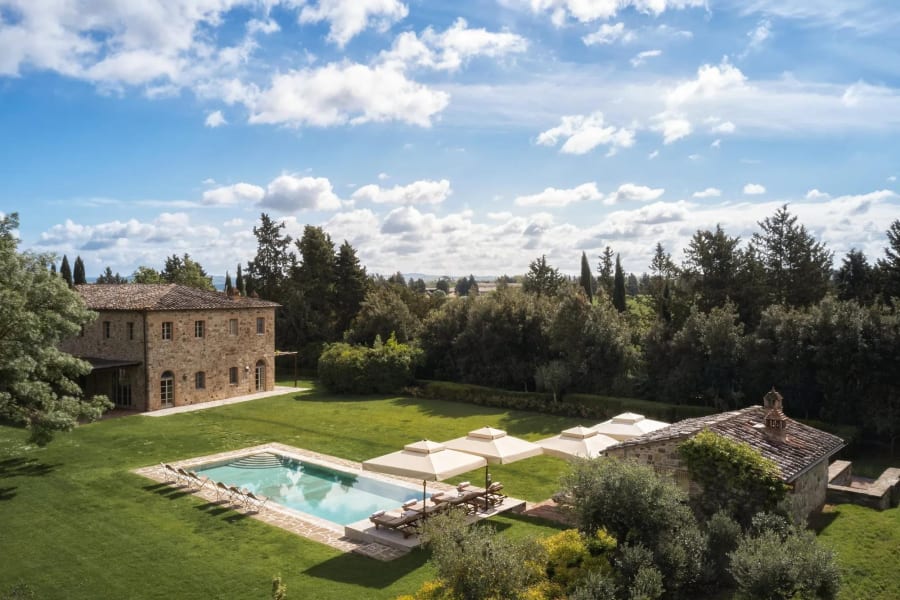
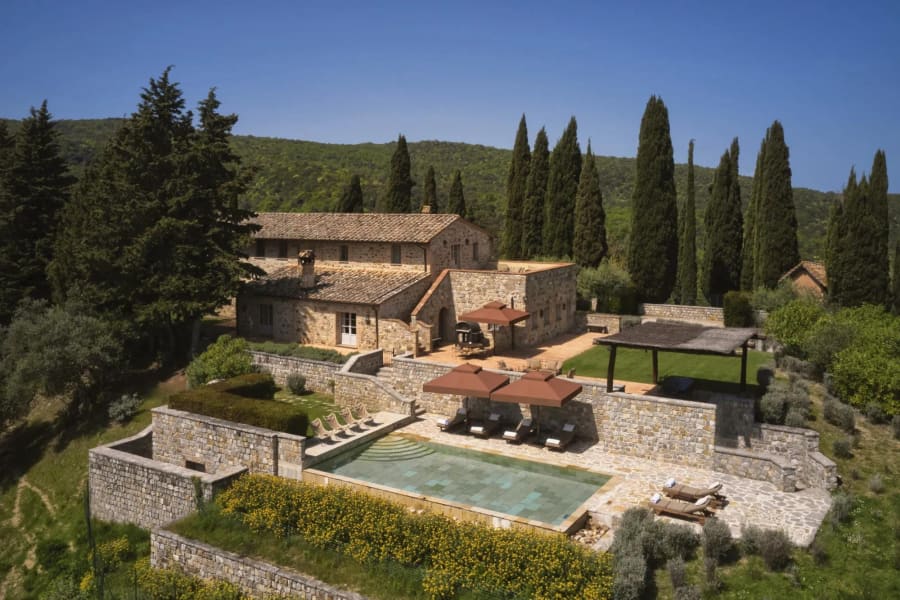
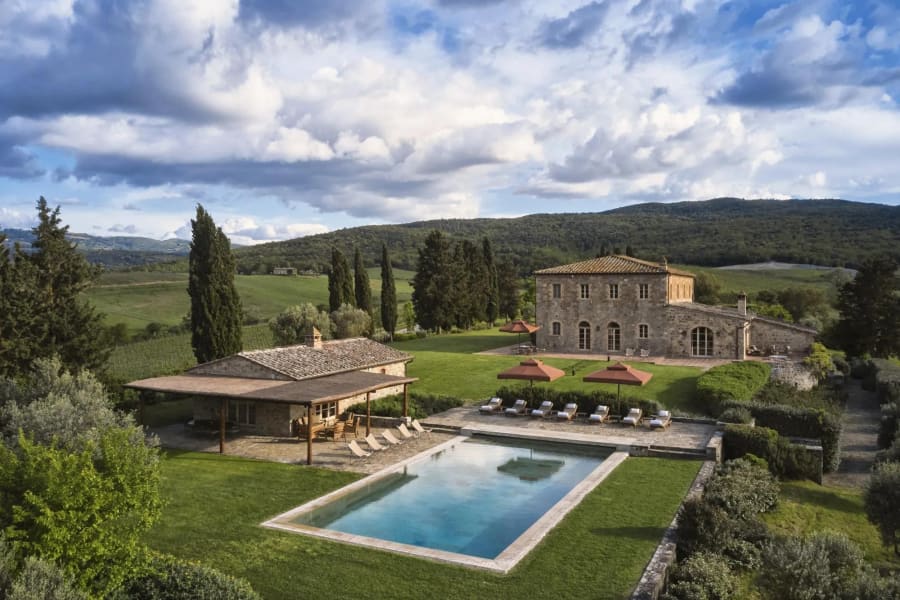
Casa di Settepini, on a southern slope above San Quirico, with full panoramic view of the valley, and the architectural Bertelli intervention that the brief calls Architectural Landmark. The view of the morning fog from the loggia at 6:30am is one of the rewards of staying here.
Tenuta del Faggio, near Sant'Antimo, the working Brunello producer's estate, with the cantina and the vineyards as part of the rental. The combination of the spring landscape and the cantina at full Brunello vertical accessibility is the stronger argument for staying here in spring than in any other season.
one of the Val d'Orcia houses, the quieter alternative, on the Pienza side. For couples and small groups who want the spring landscape without the larger-villa formality.
When to come
If you must pick one week: the third week of April or the first week of May. The wheat is at full green, the wildflowers are at their first peak, the daytime weather is reliable, the day-tripper density has not yet built. Easter week (when it falls in April) is more pressured; the week after Easter is one of the strongest single weeks of the year.
If you want the poppy week specifically: 12–22 May is the conventional window. Year-on-year variation is significant; the producers we work with can confirm the poppy state seven to ten days ahead.
The first week of June is the structural transition to early summer. Daytime highs are starting to push past 24°C; the wheat is starting to amber; the cantinas are still accessible but starting to fill. The right week for guests who want the spring landscape and the start of the early-summer evenings.
Frequently asked
When is the best time to visit Val d'Orcia in spring?
The third week of April and the first three weeks of May. The wheat is at full green, the wildflowers are at their first peak, the cantinas are at their most accessible, and the day-tripper density has not yet built to summer levels.
When are the poppies in Val d'Orcia?
Mid-May, typically 12–22 May. Year-on-year variation is meaningful; the producers we work with confirm the poppy state 7–10 days ahead.
Where is the Cappella di Vitaleta?
The Cappella di Vitaleta is a small Renaissance chapel sitting alone on a ridge five kilometres west of Pienza, on the road to San Quirico. The chapel is one of the most photographed buildings in the Val d'Orcia and is reached by a 500-metre walk from a parking pull-off on the SP146.
Is Val d'Orcia good for a photography trip?
Yes, and the spring (mid-April to late May) is the strongest single window. The combination of the morning fog, the wheat fields at full green, and the wildflowers along the verges produces the canonical Val d'Orcia photographic register. The Pienza-Montepulciano road (SP146), the Cappella di Vitaleta, and the SR2 cypress avenues are the principal locations.
Is Easter a good time to visit Val d'Orcia?
Easter week is one of the most pressured weeks of the spring on accommodation; the strong alternative is the week immediately after Easter, when the city has cleared and the countryside is at its full spring register.